
Erecting a building without obtaining a permit, or carrying out construction in breach of an existing permit, is not merely an administrative zoning violation; it is also a self-standing offence regulated in the Turkish Criminal Code (Türk Ceza Kanunu, TCK). Known as the offence of causing zoning pollution (imar kirliliğine neden olma suçu), this provision appears in TCK m. 184 in six paragraphs and is frequently confused in practice with administrative sanctions. In this article we examine the elements of the offence, the penalties laid down, the limits of its scope and the provision on effective remorse (etkin pişmanlık) in the light of the legislation as at 17.09.2026. The subject remains topical for landowners, for contractors (müteahhit) and for projects carried out within the framework of urban transformation alike, since even a minor procedural error in the permit process may become the subject of a criminal investigation.
- A person who erects, or has another erect, a building without a permit or in breach of a permit is punished under TCK m. 184/1 with imprisonment from one to five years.
- A person who permits industrial activity in a building that has no occupancy permit (yapı kullanma izni) faces imprisonment from two to five years (TCK m. 184/3).
- With the exception of the third paragraph, the provisions of the article apply only within municipal boundaries or in places subject to a special zoning regime.
- If the perpetrator brings the unpermitted building into conformity with the zoning plan and its permit, no public prosecution is brought in respect of the first and second paragraphs, and any prosecution already brought is discontinued.
- The limitation period for prosecution (dava zamanaşımı) of the offence is eight years under TCK m. 66/1-e; the offence is not dependent on a complaint and is investigated of the authorities’ own motion.
What Is the Offence of Causing Zoning Pollution? (TCK m. 184)
The offence of causing zoning pollution penalises construction carried out without a building permit (yapı ruhsatı) or in breach of a permit, the provision of utility connections to unpermitted construction sites, and the granting of permission for industrial activity in buildings that have no occupancy permit. The offence is located in the “Offences Against the Environment” chapter of the “Offences Against Society” part of the Turkish Criminal Code; the legal interest protected is the achievement of planned and supervised urbanisation.
Elements of the Offence
For the offence to arise it is sufficient that no building permit was obtained at all, or that construction was carried out in breach of the permit obtained; no damage need occur in addition, since the offence is one of endangerment (tehlike suçu). The perpetrator’s intent must be such that he acts in the knowledge that he is erecting a building without a permit or in breach of one; for a person who acts in the belief that no permit is required in a settlement area, the provisions on mistake are assessed separately.
Who Can Be the Perpetrator?
Because the wording of the article uses the expression “a person who erects or has another erect a building”, both the contractor who actually carries out the construction and the owner of the structure, that is the person who has it erected, may be the perpetrator. In practice the owner, the contractor and, in some cases, the project designer (proje müellifi) or the building inspection officer may also fall within the scope of responsibility depending on the nature of the omission; in every file it must be established by concrete evidence who bears the capacity of the person “having the building erected”. In construction contracts in return for flats, the allocation of responsibility between the landowner and the contractor is assessed separately in each case, by reference to the terms of the contract and to who in fact conducted the permit process; being registered as the owner in the land registry does not, on its own, create the capacity of perpetrator.
Attempt and Complicity
Even where construction has been halted while still at foundation level, the mere fact that unpermitted building activity has been commenced may be regarded as sufficient for the offence to be complete; for this reason, discussion of attempt (teşebbüs) remains limited in practice. Where more than one person (the landowner, the contractor, the subcontractor) knowingly and willingly takes part in the construction process, the provisions on complicity (iştirak) may come into play; the concrete contribution of each perpetrator must be established separately.
The Acts Regulated in TCK 184 and Their Penalties
The article consists of six paragraphs, each of which regulates a different act and a different level of penalty; drawing the distinction between the paragraphs correctly is important both for the defence and for the correct classification of the offence.
| Paragraph | Act | Penalty |
|---|---|---|
| Paragraph 1 | Erecting, or having another erect, a building without a permit or in breach of a permit | 1-5 years’ imprisonment |
| Paragraph 2 | Permitting electricity, water or telephone connections to an unpermitted construction site | 1-5 years’ imprisonment (under the first paragraph) |
| Paragraph 3 | Permitting industrial activity in a building with no occupancy permit | 2-5 years’ imprisonment |
| Paragraph 4 | Limitation of the scope of application | Not a penalty, but a provision on scope |
| Paragraph 5 | Bringing the building into conformity with the permit (effective remorse) | No public prosecution is brought / the prosecution is discontinued |
| Paragraph 6 | Exception for buildings erected before 12 October 2004 | Paragraphs 2 and 3 do not apply |
Erecting, or Having Another Erect, a Building Without a Permit or in Breach of a Permit (para. 1)
This paragraph penalises both the commencement of construction without any building permit having been obtained and the carrying out of works in breach of the project, the number of storeys, the building footprint or the setback distances laid down by the permit obtained. Continuing construction after the permit has subsequently been revoked or suspended is likewise assessed within the scope of this paragraph.
Providing Utility Connections to an Unpermitted Construction Site (para. 2)
A person who permits electricity, water or telephone connections to be made to construction begun without a permit is punished with the penalty laid down in the first paragraph. The purpose of this provision is to prevent officials of the relevant institutions from providing connections without checking the permit.
Permitting Industrial Activity in a Building With No Occupancy Permit (para. 3)
A person who permits industrial activity, such as a factory or a workshop, to be carried on in a building for which no occupancy permit has been obtained is punished with imprisonment from two to five years; the fact that the lower limit in this paragraph is higher than in the other paragraphs is explained by the additional risks created by industrial activity.

Photograph: Joost J. Bakker, Source: Wikimedia Commons (CC BY 2.0)
Scope of Application: Municipal Boundaries and Exceptions
Under TCK m. 184/4, with the exception of the third paragraph the provisions of the article apply only within municipal boundaries or in places subject to a special zoning regime; in areas falling outside municipal boundaries and not subject to a special zoning regime, the first and second paragraphs do not apply. Furthermore, under the sixth paragraph, the second and third paragraphs do not apply to buildings erected before 12 October 2004; that date is a transitional provision relating to the period in which the article entered into force.
Effective Remorse: Bringing the Building Into Conformity With the Permit (para. 5)
Where a person brings a building that he erected, or had another erect, without a permit or in breach of a permit into conformity with the zoning plan and its permit, no public prosecution is brought under the first and second paragraphs, any public prosecution already brought is discontinued, and any sentence imposed ceases to have effect with all its consequences. This provision is one of effective remorse, encouraging the perpetrator to bring the building into conformity with the legislation; the offence of permitting industrial activity under the third paragraph, however, falls outside its scope.
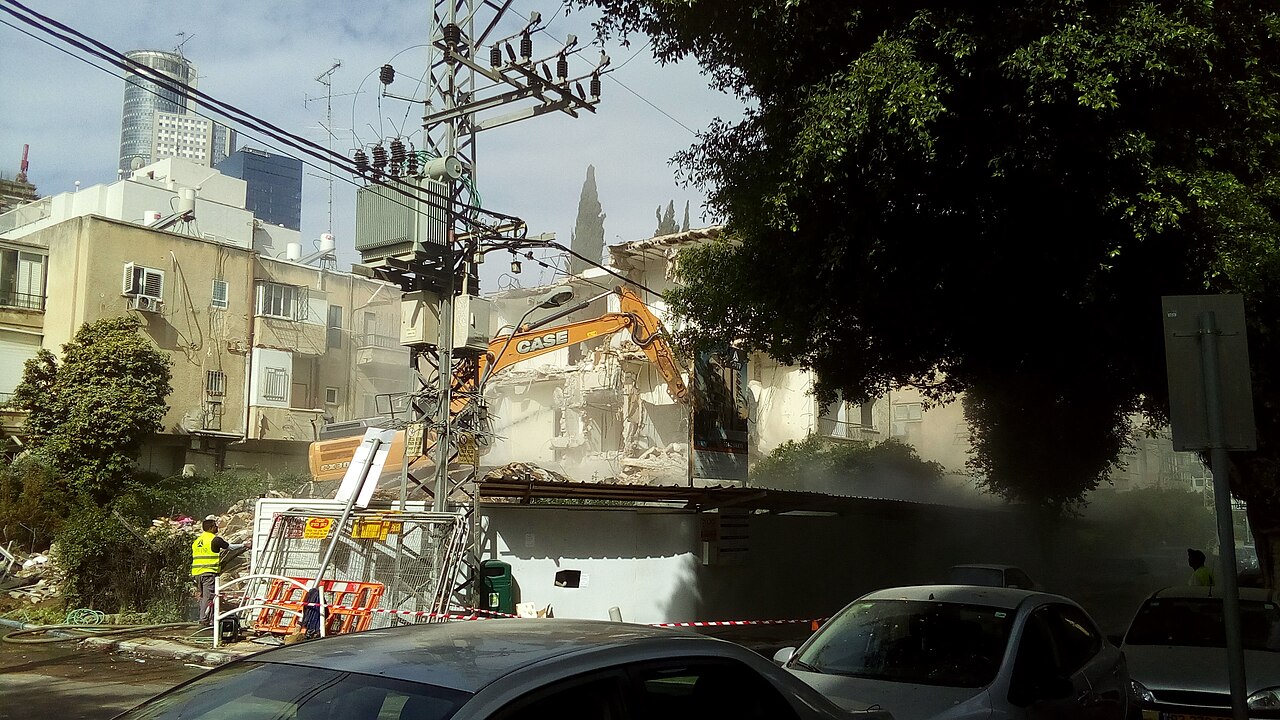
The Difference Between the Zoning Pollution Offence and Administrative Sanctions
Unpermitted construction, or construction in breach of a permit, is in addition subject to administrative sanctions under the Zoning Act; the municipality or the provincial special administration may decide to seal the building, to impose an administrative fine and, where necessary, to order demolition. For the court process to be followed against an administrative fine that has been imposed, and the applicable time limits, see our article on actions against tax and administrative fines; and if the fine becomes final but is not paid, the attachment notice procedure may also arise at the collection stage. This administrative process is conducted independently of the criminal investigation under TCK m. 184; an administrative fine and a demolition order on the one hand, and a separate criminal prosecution on the other, may arise in respect of the same building at the same time. An acquittal in the criminal proceedings, or their discontinuance, does not mean that the administrative sanctions fall away automatically; these two processes rest on separate legal bases and must be pursued separately.
Suspension of the Prison Sentence and Conversion Into a Judicial Fine
As regards the execution of the prison sentences laid down in TCK m. 184, the general provisions regulated in TCK m. 50 and 51 (conversion of a short-term prison sentence into alternative sanctions, and suspension of the sentence) may be applied where the other conditions are present. Whether these possibilities are available in a particular file depends on factors such as the perpetrator’s previous criminal record, the length of the sentence imposed and the court’s discretion, and does not lend itself to generalisation. For this reason a request for suspension or for conversion into an alternative sanction must be assessed on a file-by-file basis.
Investigation, Prosecution and Limitation
The offence of causing zoning pollution is not an offence dependent on a complaint; an investigation is opened of the authorities’ own motion upon a report by the prosecutor’s office, by the municipal enforcement officers (belediye zabıtası) or by any person. During the investigation stage a site inspection (keşif) and an expert examination (bilirkişi incelemesi) are carried out in order to establish technically the permit status of the building and its conformity with the project. At the prosecution stage the competent court is the criminal court of first instance (asliye ceza mahkemesi), since the upper limit of the penalty does not exceed five years; the court with territorial jurisdiction is the court of the place where the offence was committed, that is, where the building was in fact erected. As regards the limitation period for prosecution, under TCK m. 66/1-e the limitation period for offences carrying a prison sentence of not more than five years is eight years; that period begins to run from the date on which the offence was committed, and must be recalculated where circumstances interrupting or suspending the limitation period arise.
Relationship With Zoning Amnesty Provisions
Although the zoning amnesty (imar barışı) and similar arrangements enacted in the past made it possible to obtain a Building Registration Certificate (Yapı Kayıt Belgesi) for buildings meeting certain conditions, the scope and duration of such arrangements are limited by statute and they do not provide an automatic exemption from criminal liability for every building. Whether a building currently falls within the scope of such an arrangement, and the effect of that on criminal liability, must be assessed separately on the basis of the text of the relevant statute and the concrete circumstances of the file. Although holding a Building Registration Certificate may produce certain administrative consequences in terms of the zoning legislation, it does not mean that criminal liability under TCK m. 184 is removed on its own and automatically; since the scope of the current arrangements on this point may change from time to time, the date of the certificate and the date on which the statute entered into force must be examined on a file-by-file basis.

Photograph: Blogtrepreneur, Source: Wikimedia Commons (CC BY 2.0)
Unpermitted construction very often arises within a construction relationship in return for flats; for the contractual responsibilities of the contractor and the landowner you may consult our article on the construction contract in return for flats.
The Responsibility of Building Inspection Officers and Municipal Staff
While TCK m. 184/2 penalises the person who permits utility connections to be made to construction begun without a permit, the responsibility of municipal or institutional staff who neglect this duty is, in practice, a separate matter of debate. Whether the public official acted with the intent of misconduct in public office or through a negligent omission is important in drawing the line between TCK m. 184/2 and the offence of misconduct in public office (görevi kötüye kullanma, TCK m. 257). The responsibility of building inspection bodies and their officers, on the other hand, is assessed primarily through administrative and professional sanctions under the Building Inspection Act no. 4708, together with separate criminal liability where required.
Illustrative Case Study
The example below is entirely fictitious and is not based on any real client or file; it has been prepared purely by way of illustration, in order to explain how the offence operates in practice.
A fictitious person, (K), begins construction of a three-storey building on his plot within municipal boundaries before the permit application has been completed. In an inspection, the municipal enforcement officers establish that the construction is unpermitted and report the matter to the Chief Public Prosecutor’s Office (Cumhuriyet Başsavcılığı). At the end of the investigation, a public prosecution is brought against (K) under TCK m. 184/1. While the proceedings are pending, (K) applies to the municipality, completes the outstanding permit formalities and brings the building into conformity with the approved project; once this is notified to the court, the public prosecution already brought is discontinued pursuant to the fifth paragraph. This fictitious example shows how the provision on effective remorse may operate in practice; in every file, however, whether conformity with the permit has been achieved is examined separately on technical grounds.
In the same fictitious scenario, if (K) had been unable to bring the building into conformity with the permit, and it had been established that the construction was completed within municipal boundaries and dated from after 12 October 2004, the proceedings would have continued under TCK m. 184/1 and the court, assessing the expert reports and witness statements in the file, would have fixed the concrete sentence somewhere between one and five years’ imprisonment. This illustrative comparison shows how the provision on effective remorse may fundamentally change the course of a file.
Points to Watch in the Defence
From the point of view of the defence, the first requirement is that the perpetrator be correctly identified, that is, the person who actually “erected or had another erect” the building; on plots with more than one co-owner, who bears responsibility must be established by concrete evidence. Secondly, it must be investigated whether the building lies within municipal boundaries or in a place subject to a special zoning regime, and thirdly, whether it was erected before 12 October 2004. Finally, assessing the possibility of bringing the building into conformity with the permit during the proceedings may raise the prospect of benefiting from the provision on effective remorse. The content of the expert reports also plays a critical role in the defence; the date of the zoning legislation on which the report was based, and whether the measurements and the photographic record were made in accordance with proper procedure, may be made the subject of objections.
For the rights held in the capacity of a suspect during the investigation stage, you may consult our article on the rights of the suspect at the statement and interrogation stage. The current text of the TCK is available on the legislation pages of the Grand National Assembly of Turkey (TBMM), and precedent decisions through the case-law search system of the Yargıtay (the Court of Cassation).
What Will the Other Side Do?
In zoning pollution cases the prosecution too has its own strategy of proof; being prepared for that strategy in advance determines the points on which the defence should focus.
- It may be argued that the date on which the construction was detected is to be taken as the date of the offence and that the limitation period has therefore not yet expired. Against this, the date on which construction actually began must be clarified through photographs, zoning file records or statements by neighbours.
- It may be alleged that the perpetrator acted in the knowledge that he was erecting an unpermitted building (that is, with intent). Producing documents showing that a permit application had been made or that the process was ongoing may weaken this allegation.
- It may be alleged that the landowner too is responsible in the capacity of a person “having the building erected”. Establishing by documents, such as the construction contract in return for flats or a power of attorney, who in fact conducted the permit process answers this allegation.
- It may be argued that the provision on effective remorse cannot be applied in the concrete case because the building is still in breach of its permit. Submitting to the court the approved project obtained from the municipality and a certificate of conformity with the permit is decisive in answering this objection.
- It may be alleged that the building lies within municipal boundaries or in a place subject to a special zoning regime and therefore falls within the scope of the article. Examining the official records relating to the zoning status of the location and to the municipal boundaries (the land registry record, the municipal boundary map) clarifies this point.
Which allegation comes to the fore varies according to the state of the building, the stage reached in the permit process and who bears responsibility; for this reason it is important to gather the relevant documents before the investigation begins. To assess in advance the defence your file is likely to meet, you may get in touch.
Frequently Asked Questions
Is the zoning pollution offence dependent on a complaint?
No. The offence is investigated of the authorities’ own motion; an investigation may be opened upon a report by the prosecutor’s office, by the municipal enforcement officers or by any person.
If I subsequently bring an unpermitted building into conformity with its permit, will I avoid a penalty?
Under TCK m. 184/5, if the building is brought into conformity with the zoning plan and its permit, no public prosecution is brought in respect of the first and second paragraphs and any prosecution already brought is discontinued; the offence of permitting industrial activity under the third paragraph, however, falls outside this provision.
Is unpermitted construction in a village or outside municipal boundaries punishable?
With the exception of the third paragraph, the provisions of the article apply only within municipal boundaries or in places subject to a special zoning regime; outside these areas, the first and second paragraphs do not apply.
Which court will hear the case?
Since the upper limit of the penalty does not exceed five years, cases concerning the offence of causing zoning pollution are heard by the criminal court of first instance.
What is the limitation period for prosecution?
Under TCK m. 66/1-e, for this offence, which carries a prison sentence of not more than five years, the limitation period for prosecution is eight years.
Can the contractor and the landowner be held responsible at the same time?
Both the contractor who actually erects the building and the landowner who has it erected may be treated as perpetrators if, in the concrete case, intent and an actual contribution on their part are present; this point is examined separately according to the evidence in the file.
Does a demolition order by the municipality affect the criminal proceedings?
No. An administrative demolition order and an administrative fine form a process independent of the criminal investigation under TCK m. 184; neither is an automatic consequence of the other and each must be pursued separately.
Can the prison sentence be suspended?
The institution of suspension regulated in TCK m. 51 may be applied in a particular file depending on conditions such as the perpetrator’s history and the length of the sentence imposed; no general rule can be given on this point, and the file must be assessed by the court.

Photograph: advokatsmart.no, Source: Wikimedia Commons (CC BY 2.0)
Conclusion
Although the offence of causing zoning pollution is on the face of it perceived as an administrative zoning violation, it is a serious type of offence carrying up to five years’ imprisonment. Correctly assessing the distinction between the paragraphs, the scope of application and the provision on effective remorse is decisive at both the investigation and the prosecution stage. For an assessment of your file on this subject, you may obtain information about our criminal law practice area. Your particular situation needs to be assessed separately on the basis of your own file.
Related Articles and Resources
In connection with this subject, our articles on aggravated fraud and on rights at the statement and interrogation stage also contain useful information. For keeping track of current data and legislation, the resources of the Case-Law Search System of the Yargıtay and of the Union of Turkish Bar Associations may be used.
Table of Time Limits
| Time limit | How long | Starting point |
|---|---|---|
| Limitation period for prosecution | 8 years | From the date on which the offence was committed |
Sources
- Legislation Information System (mevzuat.gov.tr)
- Legislation Information System (mevzuat.gov.tr)
- tbmm.gov.tr
- Case-Law Search System of the Yargıtay
- Union of Turkish Bar Associations
- KVKK Data Breach Notification: The 72-Hour Rule and Article 12
Related Articles
- Delay and Penalty Clauses in a Construction Contract in Return for Flats
- Actions Against Tax and Administrative Fines: Time Limits and Stay of Execution
- Attachment Notice (89/1-89/2-89/3): What Should the Third Party Do?
- The Rights of the Suspect at the Statement and Interrogation Stage: The First 24 Hours
- The Distinction Between Fraud and Aggravated Fraud: Commission Through Information Systems
This article is for general information only and does not take the place of legal advice. Your particular situation needs to be assessed separately on the basis of your own file.
This article has been prepared on the basis of the legislation in force as at 17.09.2026.
Av. Yahya Köse
Enforcement and Bankruptcy Law, Real Estate Law, Lease and Eviction Law, Criminal Law, Dispute Resolution, Preventive Law
View the lawyer’s profile